 |
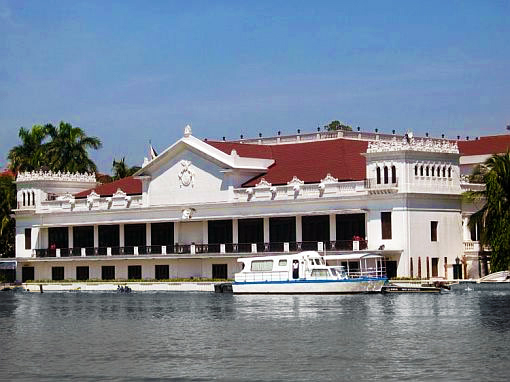
| Malacañang Palace, the residence of the Philippine president, from the other side of the Pasig River The President of the Philippines is the head of state and head of government of the Republic of the Philippines. According to the Philippine government, the office has been held by politicians who were inaugurated as President of the Philippines, following the ratification of the Malolos Constitution that explicitly declared the existence of the Philippines. Emilio Aguinaldo, leader of revolutionary forces first against Spain rule and then against United States of America, became president of the short-lived Malolos Republic in 1899. He was captured by American troops in 1901, ending his presidency. The republic never received international recognition. The Philippine government considers Aguinaldo to be the country's first president. During the American colonial period (1898–1946), the President of the United States was head of state and the American Governor-General of the Philippines was the chief executive of the Insular Government. As part of a ten-year plan to transition to full Philippine sovereignty, the Philippine Commonwealth was established in 1935 and the governor-general was replaced by the elected President of the Commonwealth. Manuel L. Quezon was the first President of the Commonwealth and is considered the second Philippine president. During the Second World War, the Philippines had three Presidents - one de facto and two de jure – with two concurrently heading rival governments either under Allied or Axis influence.[2] Presidents Manuel L. Quezon and his successor, Sergio Osmeña served under the American-controlled Commonwealth of the Philippines and its subsequent government-in-exile, respectively. President José P. Laurel was a puppet ruler of the Second Republic – a client state of the Empire of Japan, which asserted that the Philippines was independent. Before 1898, during the Spanish colonial period (1521–1898), the King of Spain was the sovereign and the Governor-General of the Philippines was chief executive of the Philippine government, known as the Spanish East Indies. |